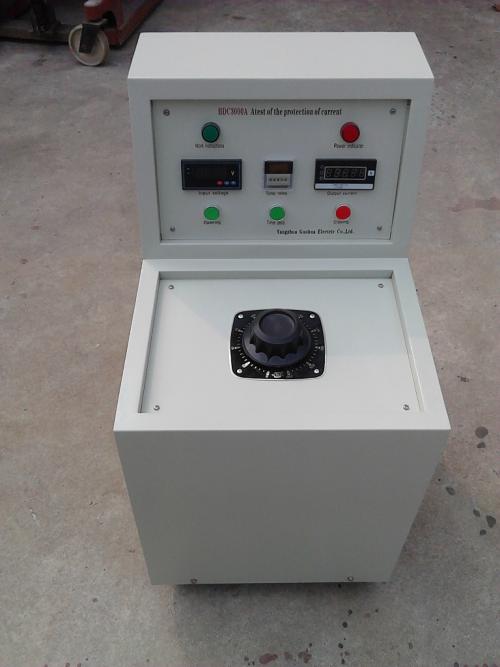
Loop Resistance Tester Dynamics
1. High Current: The high-precision loop resistance tester uses the latest power supply technology, capable of continuously outputting high current for a long time, overcoming the drawbacks of instantaneous current from pulse power supplies. It can effectively break through the oxide film on switch contacts, yielding good test results.
Results
2. High Stability: Under severe interference conditions, the last digit of the LCD screen can remain stable within ±1 digit, ensuring stable readings and good repeatability
3. High Precision: Utilizing dual-channel high-speed 16-bit Σ-Δ AD sampling and the latest digital signal processing technology, the maximum resolution reaches 0.01μΩ, making it a contact resistance tester that achieves 0.01μΩ resolution with excellent stability, surpassing imported high-current micro-ohmmeters in performance.
Performance exceeds imported high-current micro-ohmmeters
4. Intelligence: Equipped with an imported high-performance CPU, the system automatically switches ranges based on signal strength during measurement, ensuring the accuracy of the product. Over-temperature protection circuit automatically stops current output when the instrument exceeds the set temperature, ensuring safe operation.
Safe use of the instrument
5. High Quality: Key components are all imported, and a cleverly designed temperature compensation circuit effectively eliminates the influence of ambient temperature on measurement results. The use of military-grade connectors enhances vibration resistance.
6. Powerful Functionality: Current can be freely selected among 50A, 100A, 150A, and 200A, and test time can be set arbitrarily from 5s to 599s, overcoming the shortcomings of other similar instruments that cannot set measurement time or have insufficient continuous working time, far exceeding the performance of other similar instruments.
Performance far exceeds other similar instruments
7. User-Friendly Interface: Data input via a rotary mouse is convenient and fast, allowing users to set the instrument's date and time, save measurement data in real-time, and print measurement results instantly.
8. USB Transfer: Measurement data can be transferred to a USB drive via the USB interface, and further analyzed and processed with host computer software.
9. Convenient Use: Compact size, light weight, and easy to carry.
Product Introduction
Currently, the conventional QJ44 double-arm DC bridge is commonly used in power systems to measure contact resistance, but the test current of such bridges is only in the mA level, making it difficult to detect defects such as reduced cross-sectional area of loop conductors. When measuring the contact resistance of high-voltage switch conductive loops, the influence of oil film and oxide layer between contacts causes the measured value to be several times larger, failing to reflect the true contact resistance. To address this, the latest power industry standard DL/T845.4—2004 "General Technical Conditions for Resistance Measuring Devices: Loop Resistance Testers" and the new verification regulation JJG1052-2009 "Verification Regulation for Loop Resistance Testers and DC Resistance Testers" stipulate that the measurement current for contact resistance of isolating switches, circuit breakers, etc., should not be less than DC 100A, and the minimum current duration should not be less than 60 seconds, ensuring accurate test results.
The instrument's operation panel is ergonomically designed to conform to operating habits. It adopts high-frequency switching power supply and digital circuit technology, suitable for measuring the loop resistance of switch control equipment. The test current uses DC 100A and 200A recommended by national standards. The loop resistance can be directly measured at DC 100A and 200A, and the test results are displayed on a large-screen LCD, with functions such as data storage, output printing, and time setting. Additionally, 50A and 150A gears are available for user selection; custom test time can be set, with a maximum setting time of 599S, exceeding the standard's 60S; it achieves 0.01μΩ resolution and is a very stable contact resistance tester, with performance exceeding imported high-current micro-ohmmeters. It meets the requirements for on-site high-voltage switch maintenance and loop resistance testing in power supply departments and high-voltage switch factories.